

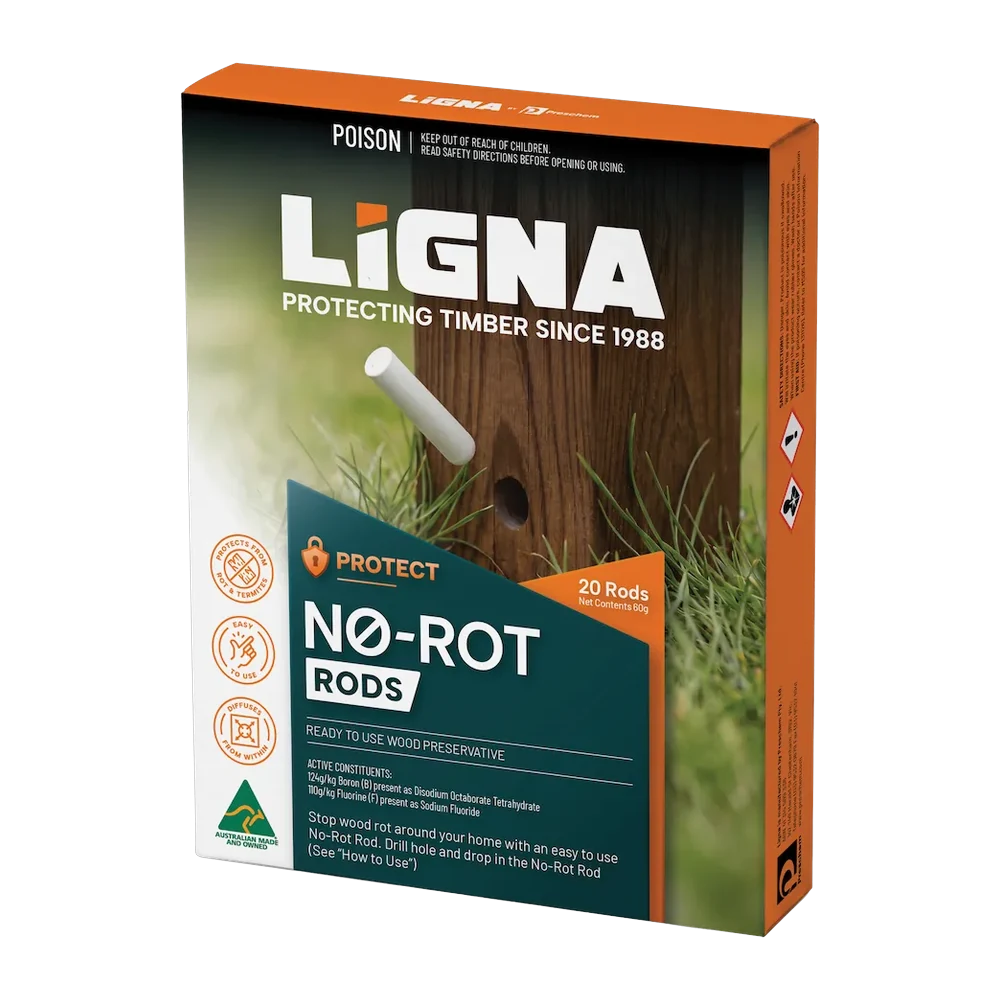
No-Rot Rods
Solid diffusion rods you drill into timber and leave. Drill, drop, plug — then they protect the joints and end grain where rot starts, for years, from the inside.
- Drill, drop, plug
- Joints & end grain
- Protects for years
- Reaches what a brush can't
- Not a termite treatment
- Not for food-contact timber
Where to get it
Find a stockist Australian made in Cheltenham, Victoria — since 1988
Not sure it's the right product?
Compare all preservatives → ·
03 9532 0679
Directions for use
Preparing the timber, then applying — as per the approved label
Before you start: if the timber is structural or load-bearing — veranda posts, bearers, joists, rafters — get a qualified professional to decide whether it can be treated or needs replacing. Preservative stops decay spreading; it can't restore lost strength.
Before you drill
- FIND Target the water traps Rot and termite attack take hold in timber above ~20% moisture. Drill where water sits and can't dry — joints, end grain, the groundline — whether or not decay is visible yet.
- CHECK Enough timber to drill? The rods need enough sound section to sit inside. Very thin or already-hollowed timber can't hold them — that's a job for No-Rot Gel, or replacement.
Installing the rods
Always read the label before use.
- DRILL Drill a 9 mm hole, 40 mm deep Using an electric drill and a 9 mm (3/8 inch) bit — straight in or at an angle — at the water traps: joints, end grain, the groundline.
- DROP Drop in the rod Insert the No-Rot rod and push it down to the bottom of the hole.
- PLUG Plug and cut flush Insert a wooden plug, leaving enough protruding to cut off flush with a saw.
How many rods
By where the timber is at risk.
| Where | Examples | Rods |
|---|---|---|
| Timber in ground contact | Poles, stumps, fence posts | 2 |
| Timber sections crossing | Pergolas, rafters & beams, decking bearers & joists | 2 |
| Exposed end grain | Beam, rafter and post ends | 1 |
| Butt-joined timber | Windows, sashes & sills, fence rails, handrails | 2 |
Termites can bypass itNot a treatment for an existing infestation — protects only the treated zone.Tap for more
POISON · As per the approved label
Safety & hazards
Signal word, restraints and first aid — from the approved label
As per the approved label. Always read the label before use.
Poisonous if swallowed; will irritate eyes and skin. Wear rubber gloves; wash hands after use. Keep out of reach of children. Read safety directions before opening or using.
Use synthetic rubber (PVC) gloves when handling No-Rot. May irritate the nose and throat. Avoid contact with eyes and skin. Do not inhale dust. Wash hands after use.
- Do not use in timber that may come into direct contact with foodstuffs, food-preparation areas or food utensils.
First aid
If poisoning occurs, contact a Doctor or Poisons Information Centre (13 11 26). If swallowed, drink water or milk and seek immediate medical attention. If in eyes, hold eyes open and flood with water for at least 15 minutes and see a Doctor.
Full safety directions and first aid are on the product label and the Safety Data Sheet.
Where it goes
The spots that rot first
Rot almost always starts where water gets trapped and can't dry — joints, end grain, and anywhere two timbers meet. Those are exactly where the rods go.
Protection that comes from inside the timber
Why it works
Most treatments coat a surface. No-Rot Rods sit inside the wood and diffuse outward as it takes up moisture — which is exactly when and where decay would otherwise start.
Releases for years
Boron and fluoride diffuse slowly out of the rod into the surrounding timber. Fit them once and they keep working — replenish only when needed.
Reaches what a brush can't
Drilled inside a section, they protect timber you can't get a brush to — sealed joints, the core of a post, wood set in concrete.
Follows the moisture
Diffusion is driven by dampness — so the actives travel to the wet spots where fungi and borers would establish.
Best-performing windows in an eight-year trial
Independently tested
Untreated eucalypt windows fitted with No-Rot boron rods were the best-performing windows tested for decay resistance.
In an eight-year window-exposure trial run by CSIRO researchers and published by Forest & Wood Products Australia, No-Rot rods were drilled into holes next to the window rebates — the joints where decay starts — and replenished once at five years. Across every treatment and timber tested, the rodded windows resisted decay best.
Cookson, L. & Carr, J. (2009). Eight year final inspection of model windows exposed in the accelerated field simulator. Forest & Wood Products Australia, Project PNB037-0708. Read the report →
Technical data
Specifications
Active constituents
Pack sizes
Poison schedule
Storage & shelf life
Common questions
Do the rods work on timber that's already rotting?
Will they stop termites?
How long do they last?
Can I fit them to new timber before anything goes wrong?
You might also need
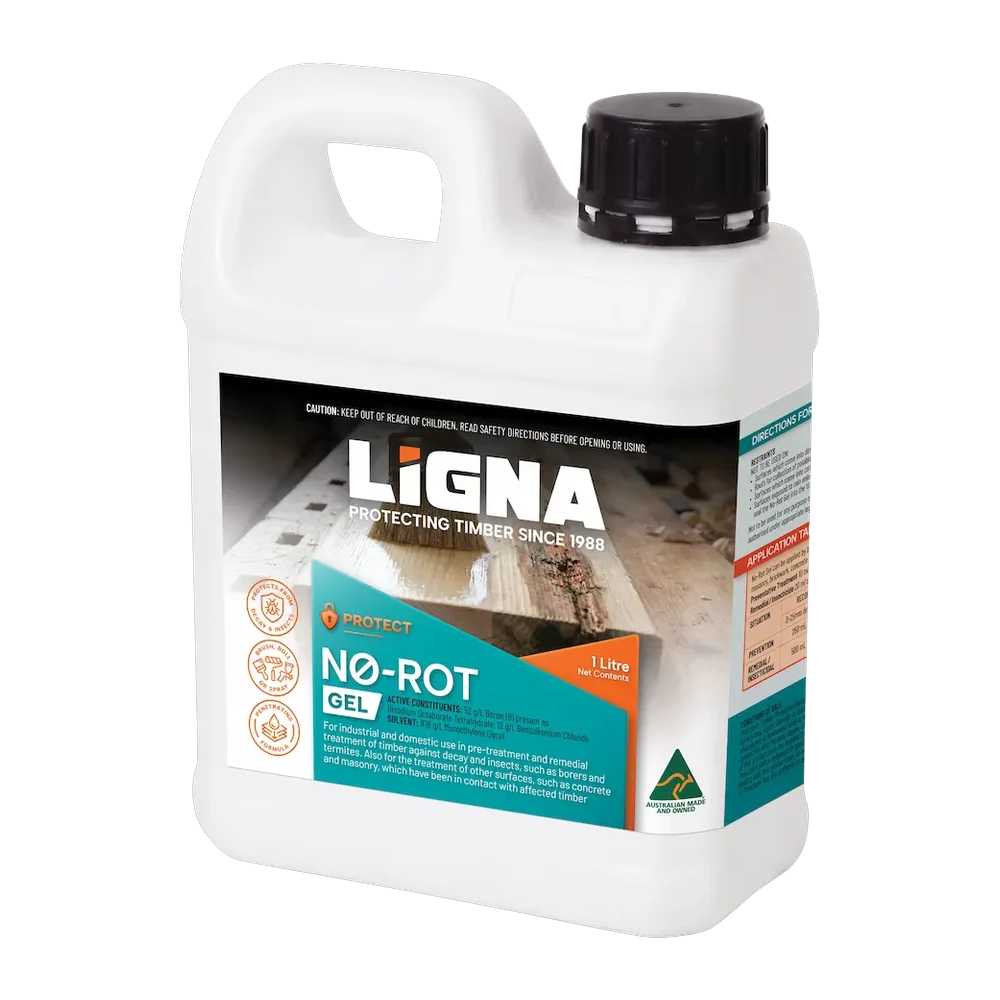
No-Rot Gel
The remedial partner — for rot you can already reach and will paint over. Same boron chemistry, brush-on.
View product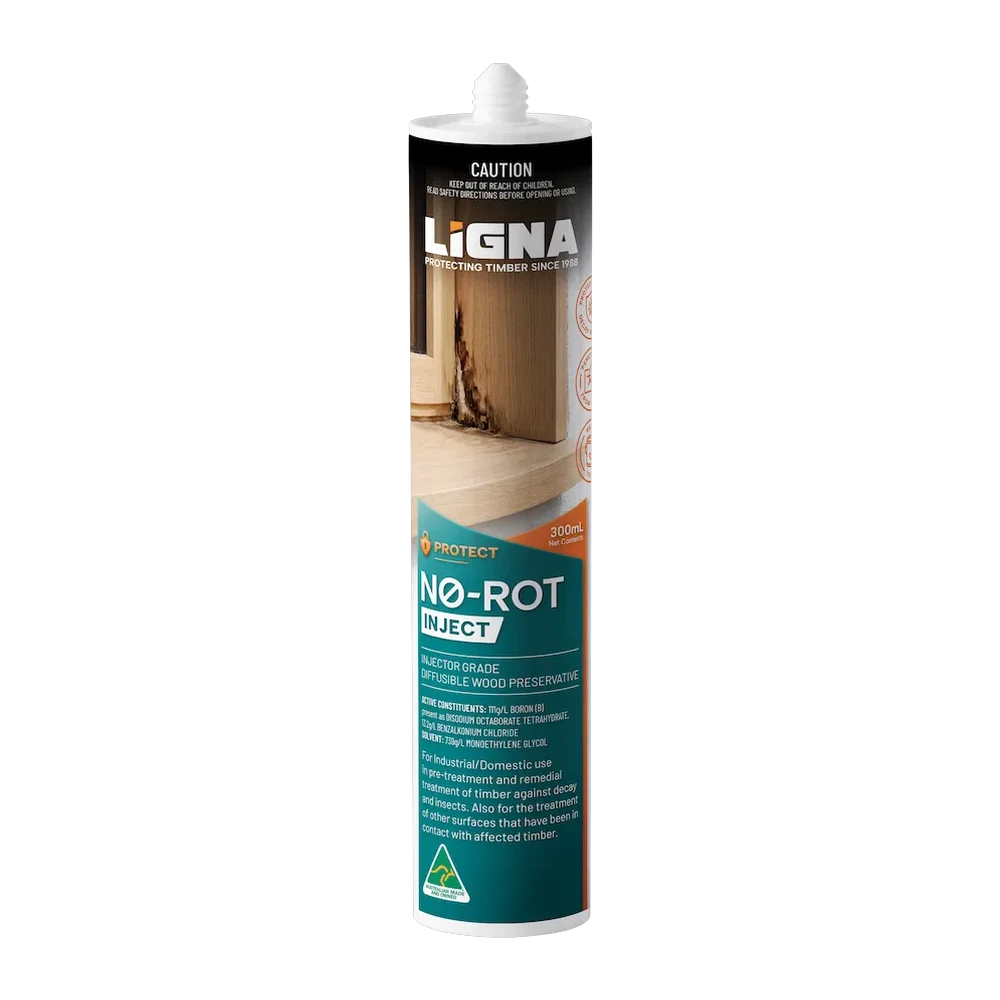
No-Rot Inject
High-strength injectable grade for protection inside structural timber and joinery.
View productPolesaver Rods
The bigger rods — PS10 for poles and posts 200–300 mm, PS14 for over 300 mm.
View productAustralian made in Cheltenham, Victoria since 1988 — founded by two CSIRO timber scientists. The whole story →