

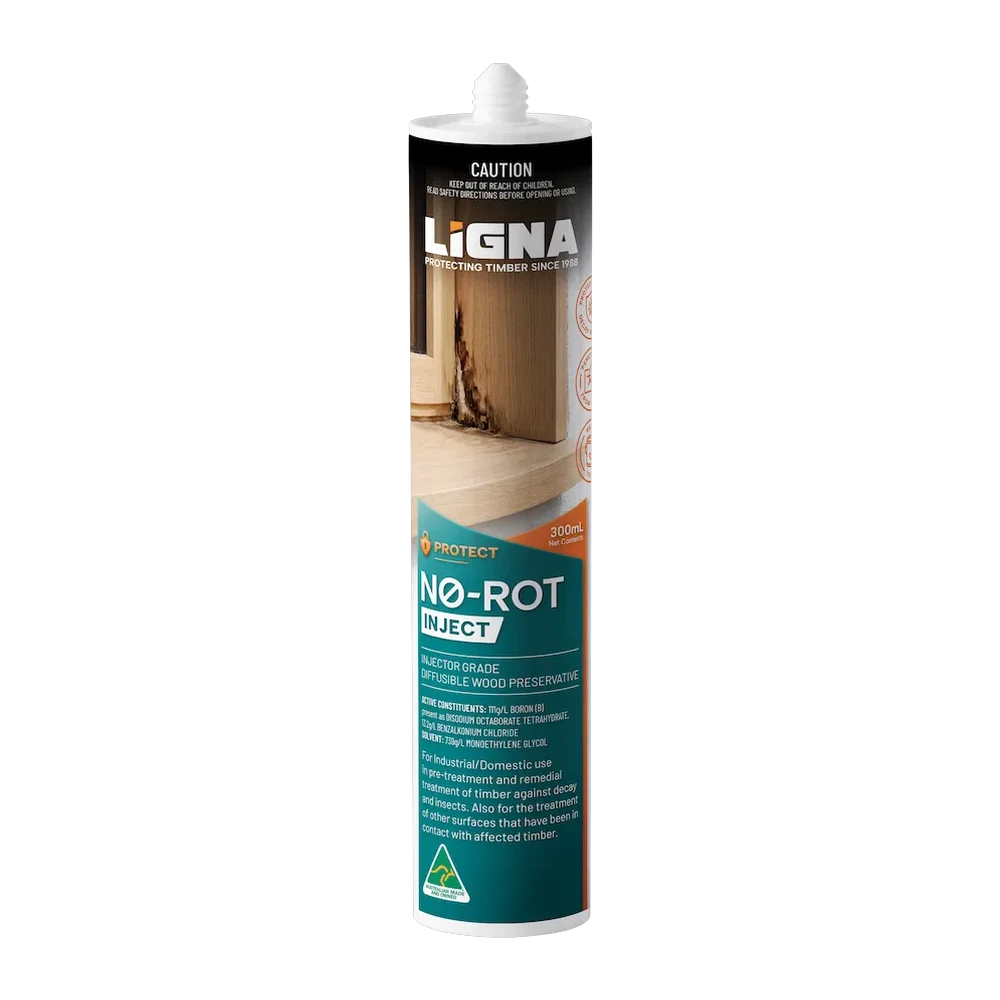
No-Rot Inject
High-strength No-Rot in a 300 mL cartridge. Spread it on, inject it into pre-drilled holes or apply it in a bandage — pre-treatment and remedial treatment of timber against decay and insects.
- Spread, inject or bandage
- Ready-to-use gel
- Preventative or remedial
- Decay & insects
- Not for ground contact
Where to get it
Find a stockist Australian made in Cheltenham, Victoria — since 1988
Not sure it's the right product?
Compare all preservatives → ·
03 9532 0679
Directions for use
Preparing the timber, then applying — as per the approved label
Before you start: if the timber is structural or load-bearing — veranda posts, bearers, joists, rafters — get a qualified professional to decide whether it can be treated or needs replacing. Preservative stops decay spreading; it can't restore lost strength.
Before you drill
- PROBE Find how far the decay goes Probe the section with an awl or screwdriver. Soft, crumbling wood is already gone; the gel protects the sound timber around it and stops the spread.
- SIZE Work out the volume to treat The label rates are per 1000 cm³ of timber. Measure the section you're treating so you can hit the rate — that's what sets how many holes, or how much to spread.
- PLAN Plan the holes Space holes to cover the zone at risk, keeping clear of fixings and the far face. Drill on the side that stays out of the weather where you can.
Applying the gel
Always read the label before use.
- SPREAD Spread it onto the surface No-Rot Inject can be applied direct into timber surfaces by spreading the product with a normal spatula or other means to achieve the application rate.
- INJECT Or inject into pre-drilled holes No-Rot Inject can be applied by injection into pre-drilled holes in timber — for example, joinery timbers.
- WRAP Or apply in a bandage No-Rot Inject can be applied in bandages to avoid dryness and to prevent it being in contact with water.
- RATE Apply at the rate for the job Supplied as a gel ready for use, for in-situ remedial or preventative treatment at the rate in the table below.
Application rate
Rate per 1000 cm³ of timber, by situation.
| Situation | Rate |
|---|---|
| Preventative treatment | 5 mL per 1000 cm³ |
| Remedial / insecticide treatment | 10 mL per 1000 cm³ |
Ready to use — no dilution.
CAUTION · As per the approved label (APVMA 61856/154879)
Safety & hazards
Signal word, restraints and first aid — from the approved label
As per the approved label. Always read the label before use.
Will damage eyes. Will irritate the skin. Repeated exposure may cause allergic disorders. Avoid contact with eyes and skin. When opening the container and preparing the product, wear cotton overalls buttoned to the neck and wrist and a washable hat, elbow-length PVC gloves and goggles. When using the product wear elbow-length PVC gloves and goggles. If product on skin, immediately wash area with soap and water. If product in eyes, wash it out immediately with water. Wash hands after use. After each day's use wash gloves, goggles and contaminated clothing.
Restraints Not for surfaces in contact with the ground or with foodstuffs, or roofs that collect drinking water. Tap for more
- DO NOT use on surfaces which come into direct contact with the ground
- DO NOT use on surfaces which come into direct contact with foodstuffs
- DO NOT use on roofs for collection of potable water
First aid
If poisoning occurs, contact a doctor or Poisons Information Centre (Phone Australia 13 11 26).
Full safety directions and first aid are on the product label and the Safety Data Sheet.
Where it goes
Inside the timber, above the ground
For industrial and domestic pre-treatment and remedial treatment of timber against decay and insects — anywhere you can drill, spread or bandage rather than brush. Not for surfaces in contact with the ground.
Treats the timber you can't get a brush to
Why it works
No-Rot Gel works from the surface in. Inject puts the same diffusing chemistry, at more than double the strength, inside the section — through pre-drilled holes or under a bandage — so it reaches decay sealed in the middle of a joint or a bearer.
Goes in through a hole
Inject it into pre-drilled holes — joinery timbers, for example — and the actives diffuse out through the timber around each hole, following the moisture the fungus needs.
Or spread, or bandage
Spread it directly onto a timber surface with a spatula, or apply it in a bandage to keep it from drying out and out of contact with water.
Preventative or remedial
Pre-treat new timber before the damp gets in, or arrest decay already established — at the higher remedial/insecticide rate, it also helps control common woodborers and termites.
Technical data
Specifications
Active constituents
Protects against
Rate, coverage & reapplication
Pack sizes
Poison schedule
APVMA registration
Storage & shelf life
Common questions
How is this different from No-Rot Gel?
Will it stop termites?
Spread, inject or bandage — which one?
How much do I need?
You might also need
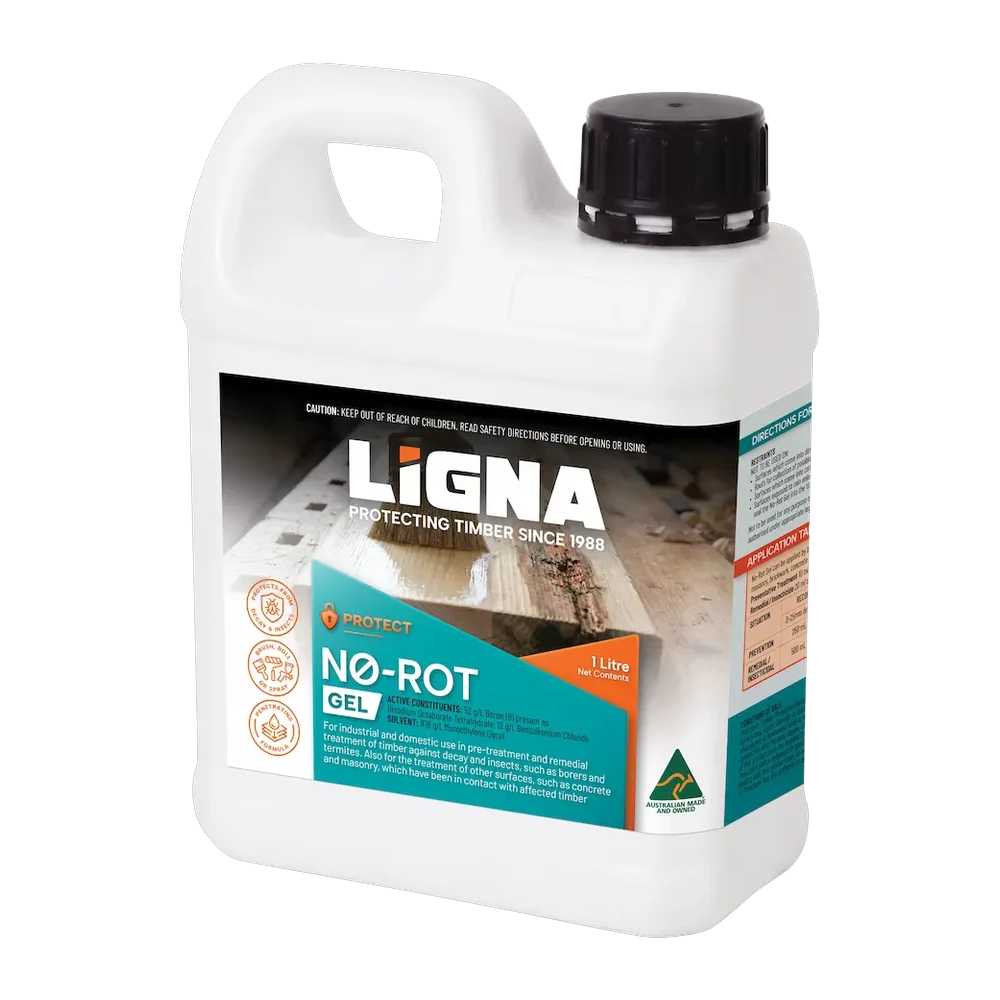
No-Rot Gel
The brush-on grade — for decay you can reach and will paint over.
View product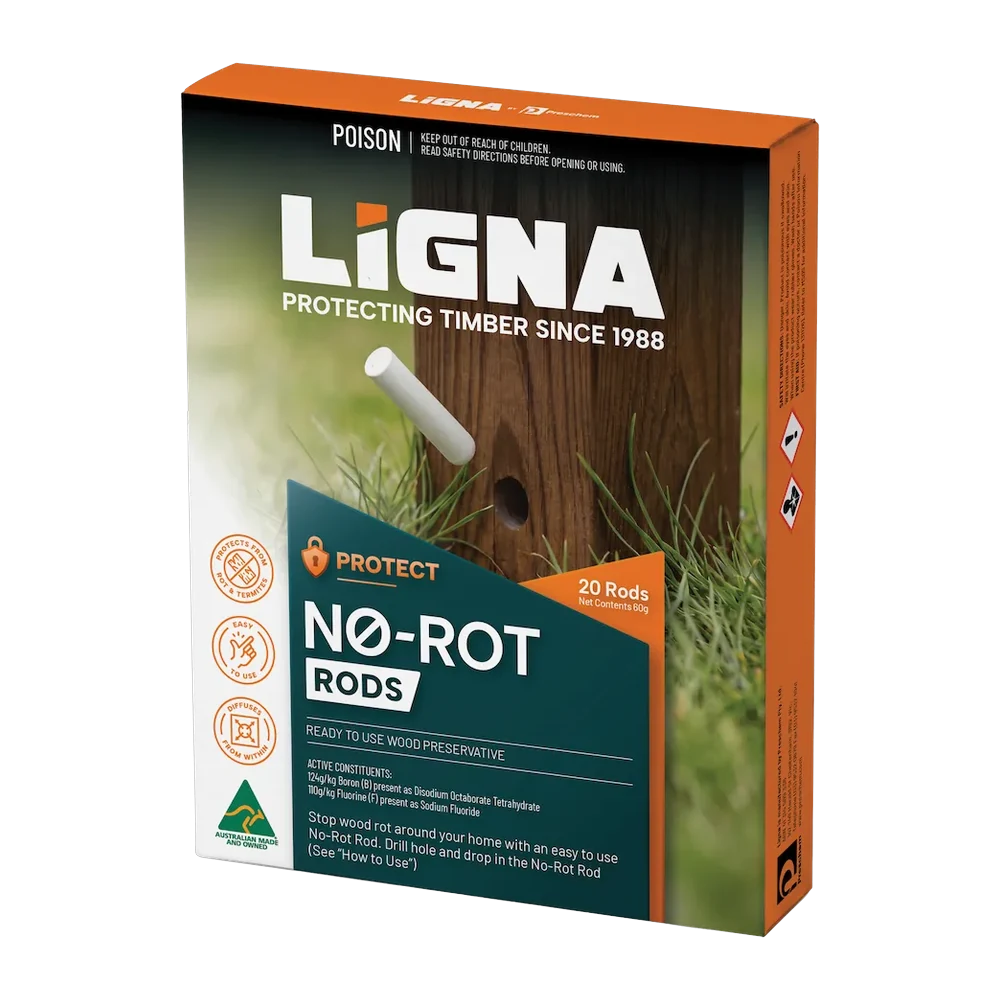
No-Rot Rods
Solid diffusion rods for the joints and end grain where rot starts — drill, drop, plug.
View productPolesaver Rods
The utility-grade rod for standing poles — groundline decay control from inside the pole.
View productAustralian made in Cheltenham, Victoria since 1988 — founded by two CSIRO timber scientists. The whole story →